SEO Is short for “Search Engine Optimization” which is practice of improvement website visibility in Organic Search Results in major Search Engines like Google, Bing and Also the AI-Powered Search Experiences (With some tweaks in the Technical Layer of SEO). Each Search Engine has it’s own Algorithms to prioritize and rank websites in their Search, but following the basics of SEO can help your website appears in most of Search Engines, Since these most of the SEO Best Practices directly correlates with the web ecosystem.
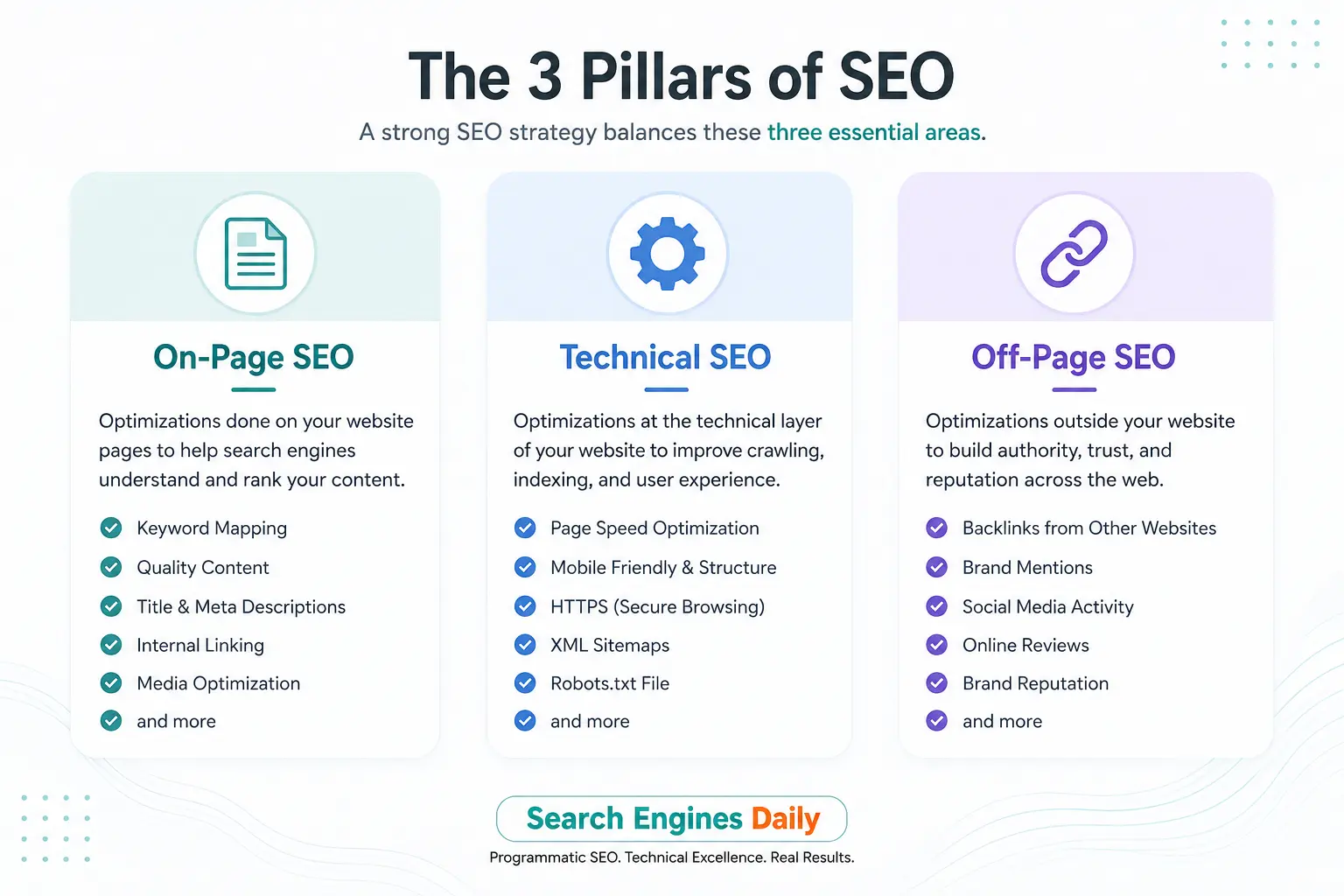
Search Engine Optimizations mainly are rooted from 3 main aspects or layers which are : Content Layer (On-Page SEO), Technical Layer (Technical SEO) and Reputation Layer (Off-Page SEO Or Brand Mentions or Many Nomenclatures that will be covered later on). Each of these micro-SEO components touch a specific optimization points, for example :
- On-Page SEO : Includes optimizations done at the page and website levels such as : Keyword Mapping across website pages, content written in the website, titles and descriptions for these pages, how your pages are linked together (Internal Links), how your website is leveraging media in content and many more aspects and optimization angles fall under On-Page SEO.
- Technical SEO : Includes optimizations done at the website Technical Layer such as : Website Page speed optimization, making the structure of the website friendly for people and bots, using HTTPS instead of HTTP (Secure Browsing), Creating XML Sitemaps, Robots.txt File and many Technical aspects all fall under the Technical SEO.
- Off-Page SEO : Includes the website reputation on the internet, how other digital sources are talking about this website, links from other websites to your website, social media activity of the brand, brand reviews on the web and many factors all of these factors represents the Off-Page SEO and we will talk about it later on a specific guide.
SEO Plays a big role a exposing the brand to new audiences through non-branded search, which means the keywords that represents your brand/product/service and is not your main brand name this is called “Non-Branded Search”.
For Businesses and webmasters, they should consider Search Engine Optimization as a serious Digital Marketing channel, because as per studies Google processes 16.4 billion Searches daily at the rate of ~189,815 Searches per Second and this serious data and statistics to consider about the Organic Search.
According to this data we can conclude the importance of SEO and Benefits of SEO For businesses , and how Search Engine Optimization can reduce the customer acquisition cost (CAC) and also SEO reduce the cost of PPC on the long run. Now, let’s move-onto the most important and exciting section of this guide, which is How SEO Actually Works.
How SEO Works, In Practical?
As we surfaced above that SEO is composed of 3 main components which are On-Page SEO, Technical SEO and Off-Page SEO, this is not only How SEO Works, SEO means “Search Engines” Optimization , which means we need first to understand how the Search Engines works , from a practical Point of View in order to easily understand core concepts in SEO , we need first to encounter in this section.
How Search Engines Works?
Search Engines are programs designed to find websites (Discovery), See these websites (Crawling), Storing these websites in their databases (Indexing) and finally presenting the most relevant results in the best or most suitable order for user in an answer to a specific search phrase or keyword. So in essence Search Engines Operates like this :
- Discovery Phase : Discovery phase is where Search Engines discover your website’ pages through internal sources (Internal Links, XML Sitemaps and other Discovery Points ) Or Through external Sources (Backlinks to Your website) from other websites, this also is Discovery entry point for Search Engines to webpages.
- Crawling Phase : Crawling phase is where Search Engines begin adding the Discovered URL to something called “Crawl Queue”, it beings preparing your URLs to Crawl it and also Crawl your website static resources (CSS, JS And Assets) which also discovered within the Crawling Phase.
- Indexing Phase : Indexing phase is where Search Engines store your website pages in their index through matching them with extracted topics and entities which have been discovered in the Crawling phase and to prepare the results to rank them in the Search.
- Ranking Phase : Ranking phase where Search Engines picks up the most relevant and eligible candidate in a specific cluster and fetch these webpages from their index and begin serving it for the users in a respond to a user query.
If you are eager to know more about Search Engines, we wrote a dedicated guide about “How Search Engines Works“, as core part of our “Search Essentials” to get to know to Search from a wider angle and scope.
And with the rise of modern web development frameworks like NextJs, Nuxt and Others another phase has came into play of the working phases of search engines which is called “Rendering“.
Rendering refers to filling up the HTML of the webpage with the proper styling and animations which are initiated by the delivered JS Payload, Rendering within Search Engines and SEO Context means the process browser takes to make a webpage fully interactive for the user, this is called “Rendering”.
And since Rendering and JavaScript SEO are 2 very big topics, we will cover them later in a dedicated guide, but here in this guide we need to tie and cohere our focus into The SEO and How Does it Works under the hood.
And the next question that will comes into your mind which is :
How to make Google and Other Search Engines Find Your Website Content?
You can right now check for number of your website pages indexed (If Any) using something called “Site:websitename.com” the “site:” followed by the domain name , this is called advanced search operator and it’s supported by major search engines like Google and Bing.
For example, you can check how many pages are indexed in my website using this search combination “site:searchenginesdaily.com“.
Google tends to recrawl URLs already indexed and known to Google and this can be spotted Google Search Console in the “Crawl Settings > Open Report > Scrolling Down To The Last Card on Left Called “By Purpose“, this represents 2 main activities or behaviors for Googlebot against your website which are :
- Refresh : Refresh means that Googlebot spend X% of it’s Crawling activity revisiting URLs it already knows
- Discovery : And Discovery means that Googlebot spend X% Discovering new content and those 2 percentages are complementary to each other.
And when we talk about Discovery we will talk about the main entry points for Search Engine bots or Search Crawlers for any website which are :
- XML Sitemaps : Search Engines discover new website pages or precisely all of website pages through XML Sitemaps, thus they are best practice in order to make your webpages are found by Search Engines.
- Robots.txt File : Robots.txt file is a simple text file which contains set of instructions , Search bots follow. For Example, you can control specific directories from being crawled using the robots.txt file and vice verse, you can only allow the crawling to a specific directory on your website and prevent the rest of website.
- External Sources : Search Engines primarily find links from external sources which they are pages they previously crawled over and over, so promoting your website on external websites helps Search Engines more to find and discover your website.
Can I Prevent Specific Sections of My website from Showing in Search?
The Answer is Yes. and there are man use-cases as webmasters we need to prevent specific directories from being discovered, crawled and indexed eventually or through mistake , like also sensitive directories or files that may contains data of your clients and many cases like this.
We need to control the indexing and even the Crawling for these routes, these is achievable and you can read Google’s Guide on the Control of What you share.
Now we have surfaced some important concepts about the Search and how it works, indexing , crawling control and how these things make the big picture of “SEO”. Now, let’s see in practical through actual basic SEO Foundations to consider while creating or restructuring your website.
Organize Your Website Pages
A well-organized website helps both users and search engines understand the relationship between your pages.
Group pages into logical categories, keep important pages close to the homepage, and avoid creating unnecessary URL depth.
A clear website structure also improves internal linking, distributes authority across your pages, and makes it easier for search engines to discover and crawl new content.
As your website grows, maintaining a scalable structure becomes one of the most important long-term SEO foundations
Use Descriptive and Keyword-Rich URLs
URLs should clearly describe the topic of the page using simple, readable words instead of random numbers or unnecessary parameters.
Including your primary keyword naturally in the URL helps both users and search engines understand what the page is about before opening it.
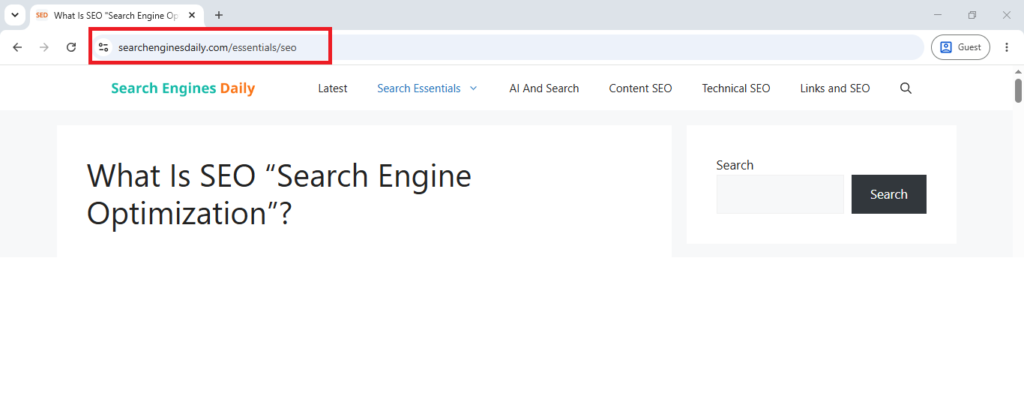
For example, this page is targeting the keyword “What Is SEO” and I for some reasons I decided to cut the stop words and only include the keyword in the URL to be as shown in the image below :
Keep URLs short, use hyphens between words, and avoid changing existing URLs unless absolutely necessary to preserve their SEO value.
Group Similar URLs by Folders and Subdirectories
Grouping related content into folders creates a logical website hierarchy that is easier for users and search engines to navigate.
For example, placing all blog posts under /blog/ or SEO guides under /seo/ makes the structure more predictable and scalable.
Proper folder organization also helps simplify internal linking, reporting, and future website expansion without creating unnecessary complexity.
Eliminate Duplicate Or Semi-Duplicate Content
Publishing multiple pages targeting the same topic often creates keyword cannibalization, where your own pages compete against each other in search results.
Duplicate or near-duplicate content also wastes crawl budget and makes it harder for search engines to identify the most authoritative version of a page.
Consolidate overlapping content, use canonical tags where appropriate, and keep each page focused on a unique search intent.
Make Your Website Helpful and Engaging
Search engines aim to rank content that genuinely helps users accomplish their goals, not simply pages optimized for keywords.
Your website should answer questions clearly, provide accurate information, and encourage visitors to continue exploring related content.
Creating helpful experiences increases user satisfaction, builds trust, and improves long-term SEO performance beyond algorithm updates.
Reverse Engineer What Your Audience Are Searching With
Effective SEO starts by understanding how your audience searches rather than guessing what they want.
Use keyword research, search suggestions, competitor analysis, and customer questions to identify topics people actively search for.
Matching your content to real search intent allows you to create pages that satisfy users and have a much higher chance of ranking.
Maintaining a Good User Experience
A positive user experience keeps visitors engaged and helps search engines recognize the quality of your website.
Fast loading speeds, mobile-friendly layouts, readable content, accessible navigation, and minimal intrusive elements all contribute to better usability.
While user experience alone does not guarantee rankings, it supports stronger engagement signals that complement your SEO efforts.
Link-Out to Relevant Sources With Descriptive Anchors
Linking to trustworthy and relevant external resources helps support your claims and provides additional value for readers.
Use descriptive anchor text that explains what users will find after clicking instead of generic phrases like “click here.”
Referencing authoritative sources also strengthens your content’s credibility and demonstrates that it is backed by reliable information.
Diversification Of Content Types And Information Representation On Your Website
Different users consume information in different ways, so presenting content in multiple formats improves accessibility and engagement.
Combine written content with images, videos, comparison tables, FAQs, diagrams, checklists, and infographics where appropriate.
Richer content experiences often improve user satisfaction while making complex topics easier to understand.
Rich-Results Enhancements And Influencing How Your Website Look In Search
Rich Results allow eligible pages to display enhanced search listings with elements such as ratings, FAQs, product details, breadcrumbs, recipes, and other structured information.
These enhancements are primarily enabled through structured data markup, helping search engines better understand the content and context of your pages.
While structured data does not directly improve rankings, it can increase your visibility in search results and improve click-through rates by making your listings more informative and attractive.
What Are Main SEO Ranking Factors Search Engines Need To See?
SEO Ranking Factors are many , but when we talk about things that move the needle in SEO there 2 main and only things which are : Content and Links. Content is what you write on your website and sure many of you encountered the term “Content Is King” and definitely it is and next strongest factor in SEO is Links.
Content
Content is the actual core and engine which all of the SEO is built upon, for a very simple example if I didn’t wrote that content about SEO, this article wouldn’t rank for it’s targeted keyword “What Is SEO”.
Create a high quality content, that address people needs , answer their question and they find it helpful , Google accordingly will reward your at the end.
Because, Google and other Search Engines tend to deliver the most helpful result possible responding to a query. An for the debate of Content length and Word count required to rank, you can watch this video by Martin Splitt (Developer Advocate, Google) and Lily Ray.
Links from other websites (Backlinks)
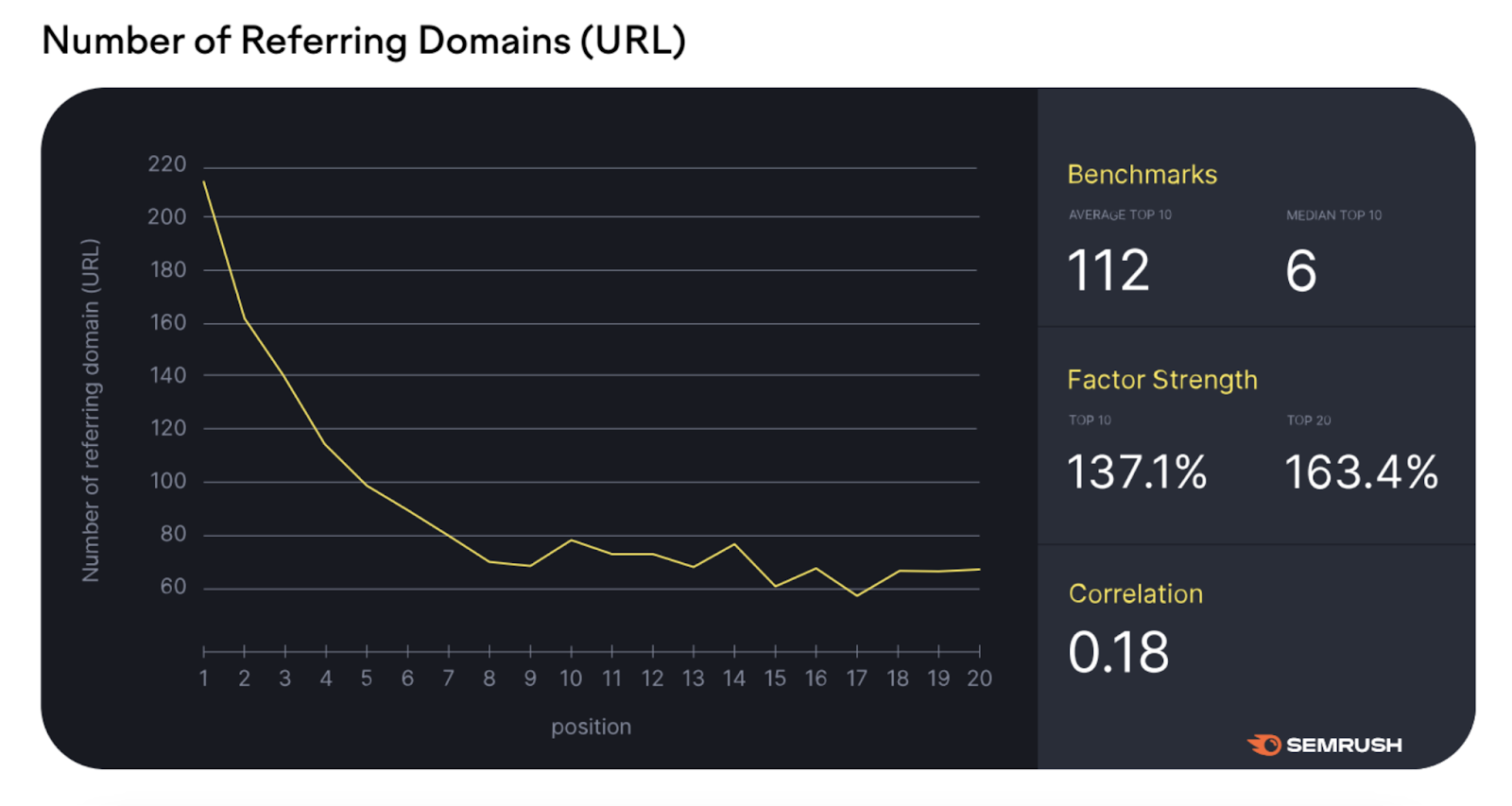
Links are the very important ranking factor in SEO, as per Semrush Blogpost about Referring Domains , it’s saying that #1 ranking pages on Google has on average 100 Referring Domain (Links from other website to target website) meanwhile , pages which are ranking below #10 has on average of 80 Referring Domain or less and here is a link to this article and in the image below a graph from this blog post shows the Correlation between links and rankings.
Beside Content and links as we said in the beginning of this section, that SEO Ranking factors are many and these SEO Factors directly comes after Content and Links in their importance and weight in ranking a website:
- Internal Links between your website pages and each other
- Usage of the HTML tags across your website and whether they are semantic HTML tags or Generic HTML Tags.
- Age of your Domain Name and date of it’s registration.
- Social Media activity for your brand. Eg: Do you share your work on Social Media Platforms Frequently?
- Making the time required to load your website is less (Optimizing For Page Speed Load Times) to offer good user experience
- How long people stays on your website, what interactions they take and pages they navigate from/to.
- The identity of the person/organization whom is responsible for creating any content piece published on your website , which is called “Authorship” In SEO.
When all of these factors of SEO combined together + other ranking factors they compose a thing a called “Ranking Algorithms” , in short these algorithms based on these factors and others factors also “Differs from Search Engine To Another” , these algorithms then matches between the most relevant result in their index in a response to a user Search Keyword, this in essence How Ranking works in SEO and How Search Engines rank websites and think of it , like interest-based index , to store and then serve the most appropriate response.
How Much Does It Take To See SEO Effect?
The answer is : It depends on many factors as we discussed above that all takes place in considering a website to rank in the top results of the Search. But generally, applying the fundamentals of SEO to your website can make your brand appears in the Search within 30 or 60 Days from the website launch.
And my appears on search means, getting initial traffic for long-tail keywords in your content, Google will begin conducting an A/B testing through showing your website randomly for a sample of users as part of getting the world knowing to your website and this phase is called “Sandbox Period of Google”.
So answering the question “How Much Does It Take To See SEO Effect” it really depends on many factors. For another example, applying Technical SEO For a big brand and running website, will take effect faster than applying technical SEO Fixations for small to medium website.
Updated On :