Agentic Browsing in Page Speed Insights are set of measurements which evaluates how easily AI Agents can browse and extract content from your website.
Agentic Browsing is a new Lighthouse category designed to evaluate whether AI agents can reliably discover, understand, and interact with website content using structured machine-readable signals.
The category examines accessibility trees, visual stability, WebMCP implementation, schema validity, and llms.txt recommendations instead of measuring traditional user performance metrics.
Agentic Browsing helps developers identify technical barriers that reduce successful interactions between AI agents and modern websites.
The category provides actionable audits instead of a weighted numerical score because the agentic web ecosystem continues to mature.
How Agentic Browsing is Scored And Calculated?
Agentic Browsing does not currently use the traditional Lighthouse scoring model that ranges from zero to one hundred.
Lighthouse calculates a fractional pass ratio representing how many deterministic readiness audits successfully pass during the page evaluation process.
Individual audits may display pass, warning, or failure states whenever technical requirements like WebMCP schemas or accessibility integrity are not satisfied.
Agentic Browsing calculations remain deterministic, allowing developers to reproduce identical results inside continuous integration pipelines while tracking technical improvements over time.
How to improve my Agentic Browsing Score?
Website owners should prioritize Semantic HTML, stable layouts, complete accessibility information, and machine-readable integrations before optimizing advanced AI-specific capabilities.
Web developers should expose forms and business functionality through WebMCP while validating every registered schema against expected technical specifications.
Content teams should publish a well-structured llms.txt file to provide AI systems with recommended crawling guidance and content summaries.
Performance engineers should continuously monitor Lighthouse audits because deterministic reports immediately reveal implementation issues affecting agent accessibility and discoverability.
Accessibility tree

Accessibility tree quality determines how AI agents understand page structure, navigation hierarchy, interactive controls, and semantic relationships across website content.
Semantic HTML elements and properly configured ARIA attributes create a reliable machine-readable representation that improves automated navigation accuracy.
Accessible names, valid parent-child relationships, and visible interactive elements strengthen the accessibility tree used by intelligent browsing systems.
Accessibility improvements simultaneously benefit screen readers, automated testing tools, search engines, and AI agents that depend on structured page interpretation.
Cumulative Layout Shift

Cumulative Layout Shift measures visual stability by detecting unexpected movement of interface elements while pages load or update dynamically.
Stable layouts allow AI agents to consistently locate previously identified elements without failed interactions caused by shifting page positions.
Image dimensions, reserved advertising space, and controlled dynamic content significantly reduce layout instability across modern websites.
Lower Cumulative Layout Shift improves both human usability and reliable machine interaction throughout browsing sessions.
WebMCP form coverage

WebMCP form coverage evaluates whether important website forms are exposed through standardized machine-readable interfaces for AI agent interaction.
Complete form coverage enables AI systems to discover available actions without relying entirely on visual browser automation techniques.
Well-defined WebMCP forms improve automation reliability for searches, registrations, submissions, bookings, and transactional workflows.
Comprehensive form exposure increases compatibility with future agentic browsing ecosystems that depend on explicit capability discovery.
WebMCP tools registered

WebMCP tools registered audit verifies whether website capabilities are successfully exposed through declarative HTML registrations or JavaScript implementations.
Lighthouse monitors tool registration events during page execution to confirm available machine-accessible functionality for AI agents.
Reliable registration ensures browsing agents consistently detect supported tools regardless of browsing environment or execution context.
Stable WebMCP registration reduces inconsistencies that may occur when dynamic JavaScript timing affects capability discovery.
WebMCP schemas are valid

WebMCP schema validation confirms that registered tools follow expected specifications required for successful machine interpretation and execution.
Valid schemas allow AI agents to understand parameters, responses, supported operations, and interaction rules without ambiguity.
Schema consistency reduces implementation errors that prevent automated systems from successfully executing exposed website capabilities
Regular validation ensures long-term compatibility as WebMCP standards continue evolving across agentic web technologies.
llms.txt follows recommendations

The llms.txt file provides AI systems with structured guidance about important website content, preferred resources, and machine-readable documentation.
Recommended llms.txt implementation helps language models identify authoritative pages while reducing unnecessary exploration across large websites.
Well-maintained recommendations improve content discoverability by providing concise summaries and navigation guidance for AI-powered systems.
Proper llms.txt configuration complements structured data and accessibility improvements to strengthen overall machine understanding.
Serving Version Of The Content In Markdown Format
One of the techniques and I have personally used on website I own is “Serving Version of Your Content In Markdown” why?, Because it’s the favorable format for LLMs to extract and understand the context.
However, Google didn’t officially say anything about Markdown formats , But I have a website and I have served a corresponding Markdown version for every HTML URL I have “Text only no code bloat”.
Result?
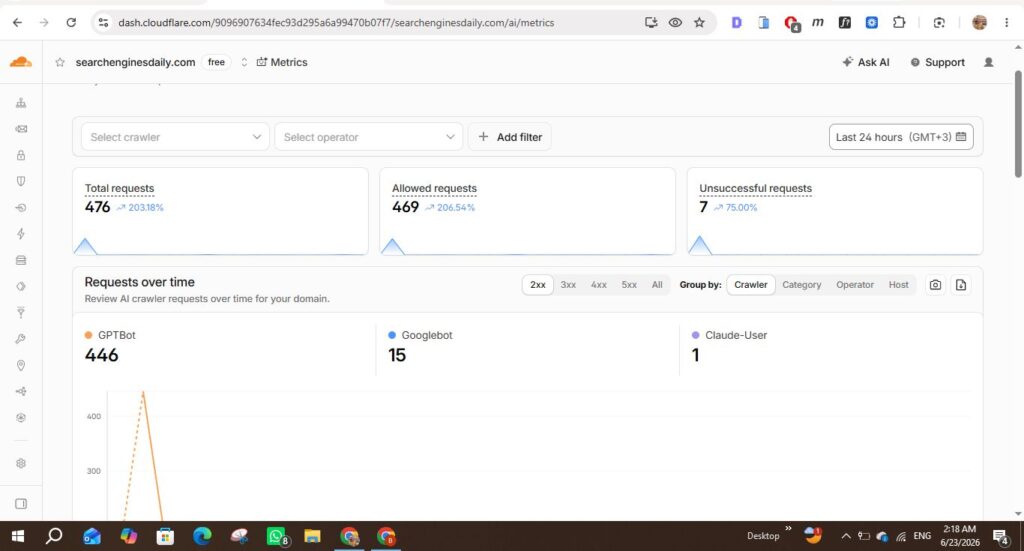
Most of the those 446 Requests made to Search Engines Daily from GPTBot most of these requests were made to the Markdown versions of my content pages and for this analysis I exported the Performance Data from CloudFlare in CSV and Uploaded it to my Google Drive and Opened it with Google Sheets, ran an app script to analyze for my total requests by breakdown and I got this :
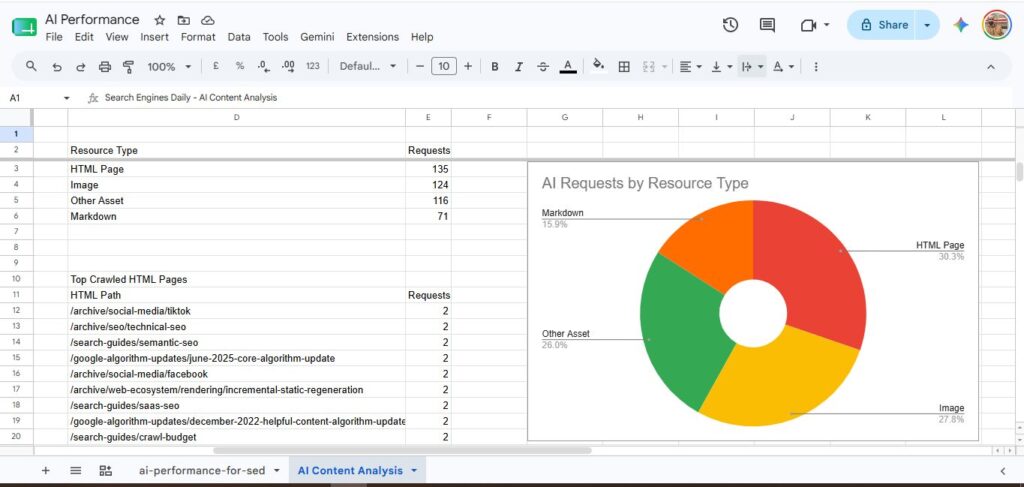
As you can see 15.9% of the total requests made by chatGPT through their bot “GPTBot” where directly targeting the Markdown versions of each piece Of content I have.
So, Agentic Browsing is influenced by Markdown format of content served all the way together with the abovementioned Techniques which mainly all of these things which I call “The Extra Technical Layer LLMs And AI Agents Need” to fetch and extract content from my website.
Why Agentic Browsing Matters For Generative Engine Optimization (GEO) and SEO?
Agentic Browsing strengthens Generative Engine Optimization by making website content easier for AI assistants, autonomous agents, and large language models to discover and interpret.
Strong accessibility, structured machine interfaces, and stable layouts increase confidence that automated systems can accurately retrieve information without interaction failures.
Technical improvements recommended by Agentic Browsing frequently align with established SEO best practices, including semantic HTML, accessibility, and consistent site architecture.
Organizations investing in agentic readiness position their websites for improved visibility across both traditional search engines and emerging AI-powered discovery platforms.
What Else I Can Do To Improve The Browsing of AI Agentic For Against My Website?
Beside the techniques we discussed above, it’s also important to consider implementing the basics of SEO, understanding how search engines works. And don’t forget to expand your knowledge about :
And don’t forget to subscribe to Search Engines Daily to our Weekly SEO Newsletter to get the SEO , AI And Search Marketing Updates directly into your inbox “We don’t spam”.